
THCA, or tetrahydrocannabinolic acid, is currently at the center of discussions in the world of hemp and cannabinoids. Long considered merely an intermediate step in the formation of THC, it is now being studied for its unique properties, biological role, and regulatory implications.
To understand THCA, it is essential to examine its chemical structure, its role in the plant, its interaction with the body, and its complex legal status.
Definition of THCA: a cannabinoid precursor to THC
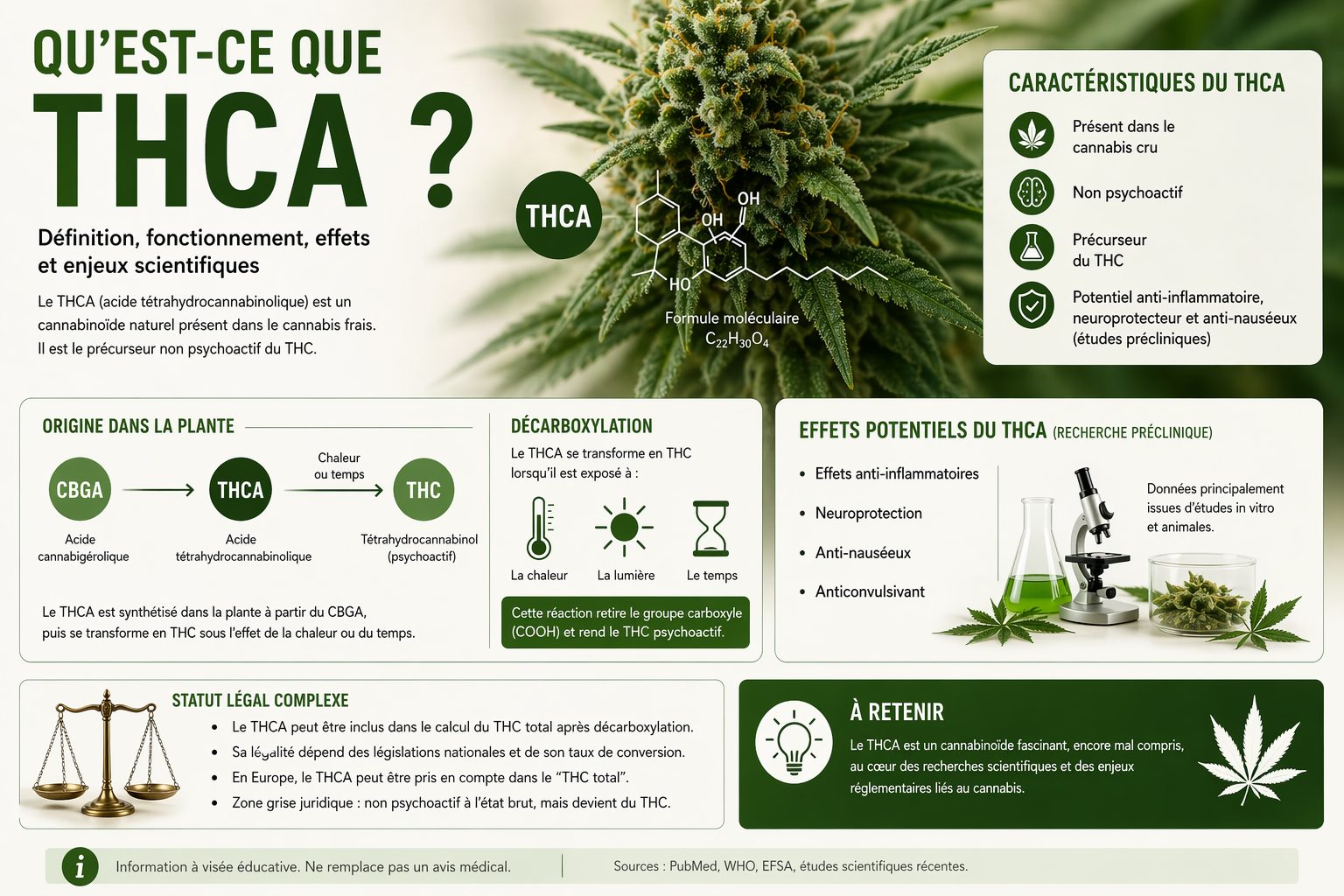
THCA (tetrahydrocannabinolic acid) is a cannabinoid naturally found in fresh cannabis. It is the acid form of THC, which means it is its direct precursor.
In the hemp plant, THCA is produced from another key cannabinoid: CBGA (cannabigerolic acid). This process is catalyzed by a specific enzyme called THCA synthase.
This point is crucial:
👉 Raw cannabis contains virtually no active THC
👉 It consists mainly of THCA
Chemical structure and differences from THC
The main difference between THCA and THC lies in the carboxylic acid group (COOH) present in the THCA molecule.
Why is this difference important?
- THCA has a heavier and more stable structure
- This structure prevents it from binding effectively to CB1 receptors in the brain
- Result: no direct psychoactive effects
Conversely, once formed, THC can interact with these receptors and cause neurological effects.
👉 In summary:
- THCA = inactive form (non-psychoactive)
- THC = active (psychoactive) form
The key process: decarboxylation
The conversion of THCA to THC is based on a fundamental process called decarboxylation.
What is decarboxylation?
This is a chemical reaction that occurs when THCA is exposed to:
- Heat (combustion, vaporization, cooking)
- Light
- Time (natural oxidation)
This process results in the loss of the COOH group and converts THCA into active THC.
A concrete example
- Raw cannabis → THCA
- Heated cannabis → THC
It is this transformation that explains why a fresh plant does not have the same effects as a heated product.
Is THCA psychoactive?
No, THCA is not psychoactive in its raw form.
Scientific data shows that:
- It does not cause euphoria
- It does not affect perception
- It does not produce the effects associated with THC
👉 The main reason:
THCA does not bind effectively to the CB1 receptors in the endocannabinoid system.
However, as soon as it is heated, it turns into THC, and the effects change completely.
Interaction with the endocannabinoid system
The endocannabinoid system (ECS) is a complex network involved in the regulation of many biological functions:
- Pain
- Mood
- Appetite
- Inflammation
- Sleep
Unlike THC, THCA acts indirectly.
Possible mechanisms
Preclinical studies suggest that THCA may:
- Activate certain non-cannabinoid receptors (such as PPARγ)
- Regulating inflammation
- Influencing neuroprotective pathways
These effects are still being studied, but they hold promising prospects.
Potential effects of THCA: What does the science say?
Research on THCA is still limited, but several scientific avenues are emerging.
1. Anti-inflammatory effects
THCA may play a role in reducing inflammation, particularly by activating certain nuclear receptors.
2. Neuroprotective effects
Studies suggest potential in:
- Neurodegenerative diseases
- Neuronal protection
3. Anti-nausea effects
THCA may affect the mechanisms involved in nausea and vomiting.
4. Anticonvulsant effects
Research is exploring its potential role in certain neurological disorders.
👉 Important:
These effects have mainly been observed in vitro or in animal models. Clinical evidence in humans remains limited.
THCA vs. THC: Understanding the Key Differences
| Feature | THCA | THC |
|---|---|---|
| Chemical form | Acid | Decarboxylated |
| Psychoactivity | No | Yes |
| Attendance | Raw cannabis | Heated cannabis |
| CB1 Interaction | Low | Strong |
| Main effects | Therapeutic potential | Neurological effects |
This distinction is essential to understanding how cannabis works overall.
The presence of THCA in the hemp plant
THCA is particularly abundant in:
- Fresh flowers
- Unheated plants
- Recent harvests
Over time, it gradually breaks down into THC, even without human intervention.
👉 This means that:
- Storage affects composition
- Exposure to heat alters cannabinoids
Metabolism and processing in the body
Once ingested, THCA follows specific metabolic pathways.
It can be converted into:
- 11-OH-THCA
- 11-nor-9-carboxy-THCA
However, if decarboxylation occurs before ingestion, THC undergoes a different metabolic process, involving 11-hydroxy-THC, which is responsible for more intense effects.
The Legal Status of THCA: A Gray Area
THCA falls into a complex regulatory gray area.
In the United States
- Le THCA issu du chanvre peut être considéré comme légal si le THC < 0,3%
- But its conversion to THC poses a problem
- Some jurisdictions regulate it strictly
In Europe
- The THC content is limited to 0.2–0.3%
- THCA may be included in the calculation of “total THC”
- Some countries implicitly consider THCA to be a potential form of THC
👉 Result:
THCA is legally unstable and depends heavily on the national context.
Scientific and Industrial Challenges of THCA
THCA is a strategic issue for the hemp industry.
1. Analytical Issues
Laboratories must measure:
- THC
- THCA
- Total THC (THC + THCA after conversion)
2. Regulatory Issues
Authorities are moving toward an approach based on:
👉 Total THC after decarboxylation
This point is key to the market’s future.
3. Business Issues
THCA is sometimes used for:
- circumvent certain regulatory restrictions
- offer products similar to THC
But this strategy remains legally risky.
THCA in medical research
THCA has attracted the attention of researchers for one major reason:
👉 It may provide some of the effects of cannabis without the psychoactive effects
This opens up opportunities in:
- Medicine
- Pharmacology
- Research on the endocannabinoid system
But at this point:
- Clinical trials are rare
- The data are still preliminary
Key Takeaways About THCA
THCA is a key cannabinoid that is often misunderstood.
Key points:
- It is the direct precursor of THC
- It is non-psychoactive in its raw form
- It is converted to THC through decarboxylation
- It offers some promising therapeutic approaches
- Its legal status is complex and evolving


