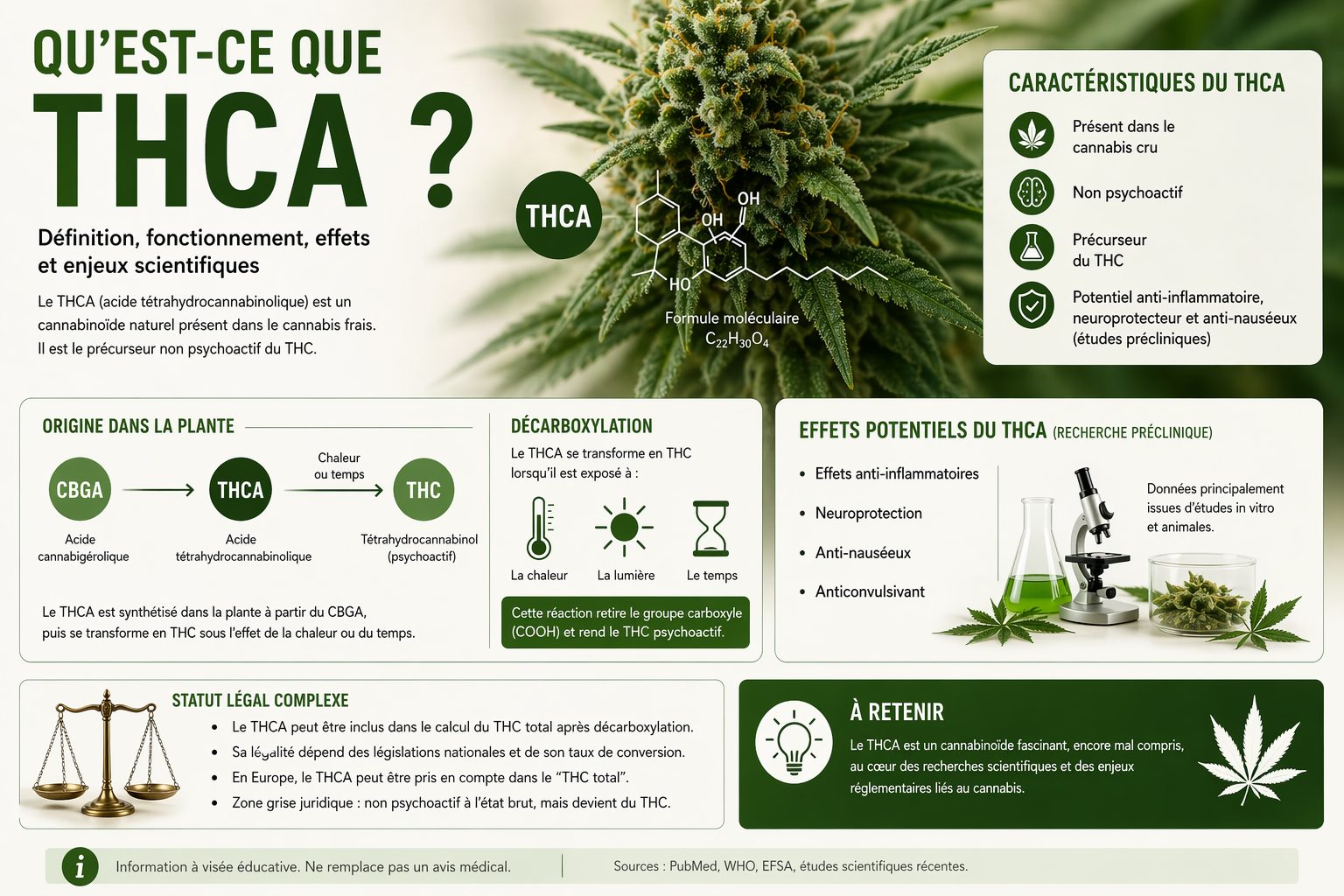
There are many cannabinoids derived from the hemp plant. Some, such as CBDare widely known to the general public. But there are over 120 different substances in the Cannabis Sativa. Each of these has specific effects on the body and are therefore used in different ways.
On the other hand, not all these molecules are present at the same time in the plant, some are the result of the transformation of other substances. So what is the difference between CBD, CBDa, CBG, CBGa and CBN?
CBGa and CBDa, the acid forms
The molecules are originally found in the plant in their acid form. It is from these molecules that other substances such as CBG or CBD.
Indeed, when the plant is exposed to heat, a decarboxylation process takes place. This means that the acid molecule loses its carbon atom and is transformed into one or more new molecules. For example CBGa becomes CBDand THC and CBG.
What is the CaGBC?
Thus, the CBGa is the acid form of CBGbut not only. Present in very small quantities in the plant CBGa is however called the "mother of all cannabinoids", as it is this substance originally present in the plant that will lead to the creation of most cannabinoids.
Indeed, following a process called Biosynthesis, the CBGa or cannabigerolic acidleads to the creation of CBDa, THCa and CBNa. Then decarboxylation takes place on contact with heat, i.e. the loss of the carbon atom. The CBGa is then transformed into CBD, THCand less than one percent of CBG.
Although still few in number, scientific research has demonstrated the benefits of benefits of CBGa on the body. For example CBGa is not psychoactive, but has effects on thecentral nervous system, the immune system and the gastrointestinal system. It is an analgesic and anti-inflammatory agent with proven therapeutic effects, for example in cases of colon cancer or diabetes. To learn more about the CBGa and its virtuessee the article dedicated to it!
What is the CBG?
As explained above, the CBG is derived from the decarboxylation of CBGa. However, the loss of carbon from CBGa leads to the creation of CBD. The CBGor cannabigerolappears only in very small quantities: the level of CBG is less than 1%. It is therefore called minor cannabinoid.
In the same way as CBD,CBG is not toxic to the body and does not cause psychotropic effects. However, the effects of CBG on the body are different from those of CBD. The CBD acts globally on the endocannabinoid systemsystem, while CBG binds to specific receptors: CB1 receptors, linked to the brain, and CB2 receptors, acting on the central nervous system.
The effects of CBG
Due to its action on the endocannabinoid system CBG has multiple effects on the body. Scientific research has revealed its anti-inflammatory properties, with a particular action on inflammatory bowel diseases. The CBG also has antifungal and analgesic properties, as well as antidepressant qualities.
Thus, the CBG can help in the treatment of psoriasis and may reduce anxiety and muscle tension. As it stimulates the appetite, the use of CBG may be of interest to people with eating disorders such as anorexia. The antioxidant effect of this cannabinoid is effective on the brain. It would therefore be able to protect the nervous system and improve certain motor deficits.
A 2014 study also indicates the potential for effects of CBG to fight against certain cancers. Thanks to its anti-oxidant and anti-inflammatory action CBG could prevent and inhibit the growth of cancer cells, particularly in colorectal cancer.
Other studies show that CBG may be useful in glaucoma. This is because it improves the circulation of eye fluids and reduces the pressure in the eye. In addition CBG improves blood circulation and allows the blood vessels in the eye to dilate. By improving oxygen supply, this cannabinoid could be useful in the treatment of various eye diseases.

CBD, the star cannabinoid
Widely studied and used CBD is one of the cannabinoids known to the general public. Also known as Cannabidiolit is derived from the decarboxylation of CBGa and CBDa. Together with THC, it is one of the substances present in the greatest quantity in the hemp plant.
However, CBD is quite different from THC: it has no psychotropic effect and is not toxic to the body. On the contrary CBD has benefits on the body. Indeed, this cannabinoid acts on the brain through its effect on the endocannabinoid system and thus has anxiolytic and antidepressant properties. Its applications are multiple and CBD can be used to fight against :
- anxiety disorders and panic attacks
- depression
- insomnia
- nausea and vomiting
- eating disorders (anorexia, bulimia)
- inflammations
- diabetes
- seizure disorders
- heart disease
- skin problems such as acne and psoriasis
- joint and muscle pain
- schizophrenia crises
- certain addictions such as alcoholism
Difference between CBD and CBDa
The CBDa is the acid form of CBD. It is therefore the CBDaor cannabidiolic acidwhich will be transformed into CBD after contact with heat. Little scientific research has been done on this acid form of CBDbut some effects are associated with it.
Just like CBDis, the CBDa has anti-inflammatory and analgesic properties, and can be used to reduce some pain. However, although the effects of the acid form are similar to those of CBDthe reaction process within the body is different.
The CBD acts directly on the endocannabinoid systemsystem, whereas CBDa does not intervene at this level. It is by inhibiting the production of the COX-2 enzyme, associated with the inflammation process, that CBDa has anti-inflammatory properties.
What is the CBN?
Also known as cannabinolthe CBN is a cannabinoid derived from THC. When the cannabis plant is exposed to heat and oxygen, a reaction occurs and THC is converted into CBN. Thus the CBN is the result of a process and does not come naturally from the plant. It is a "degraded" version of THC, and there are differing opinions about its psychoactive properties.
Indeed, the CBN has little or no psychoactive effect, but provides similar sensations to THC. Research into this cannabinoid is limited compared to studies on other substances such as THC and CBD. But although they need to be further investigated, scientific research has already shown that the use of CBN products products can have therapeutic properties.
The effects of the CBN
The use of CBN or cannabinol appears to be indicated in cases of anorexia, as it stimulates appetite and reduces nausea. The cannabinol also has anti-bacterial, anti-inflammatory and analgesic properties, allowing it to relieve certain pains. In addition, more and more studies place CBN as an effective molecule in the fight against asthma The cannabinol could therefore be used in anti-asthma treatments.
In the same way as the CBGthe CBN would be useful in cases of glaucoma, reducing eye pressure and improving blood circulation within the eye. Finally, this cannabinoid would be the most effective in the treatment of insomnia, due to its synergy with THC.