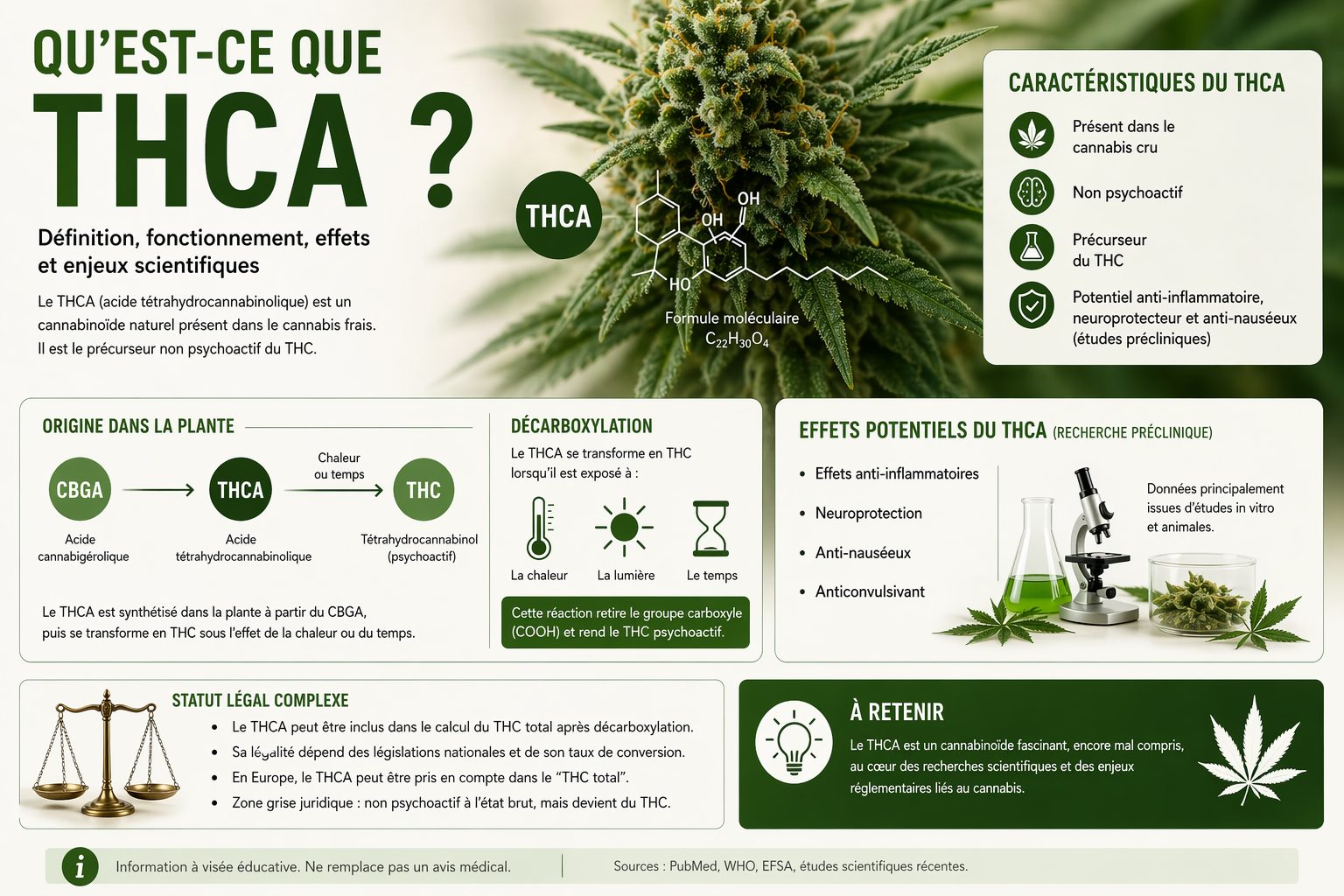
THCJD, also known as Delta-9-THCJD, tetrahydrocannabidiol-J or tetrahydrocannabioctyl , has recently come to the fore, setting itself apart from all known cannabinoids. It is attracting growing interest for its unique chemical structure and powerful psychedelic effects. In this article, we take a look at the little-known world of THCJD!
THCJD, an octyl cannabinoid
Discovered in 1976 by Dr. Raphael Mechoulam and his team at the Israeli Weizmann Institute, THCJD was the subject of pharmacological studies in 1980. It was found to have anti-inflammatory, analgesic and anxiolytic properties. This octyl cannabinoid has recently attracted renewed interest with the discovery, in 2020, of new laboratory synthesis processes.
This isomer of THC, or tetrahydrocannabinol, differs from it by possessing an 8-carbon alkyl side chain. According to Dr. Erik Paulson of the InfiniteCAL laboratory, it's this chain that gives THCJD all its potency. Tetrahydrocannabioctyl is considered to be 19 times more potent than Delta-9 and 25 times more potent than Delta-8 and Delta-10. Note that THC and CBD have only one chain of five carbon atoms. THCJD therefore has a higher affinity to cannabinoid receptors than THC and CBD.
This new star of cannabinoids therefore possesses powerful effects unique to its potential therapeutic and recreational applications. However, its potency calls for caution, especially for novice users.
Where THCJD comes from
This molecule occurs naturally in various cannabis species such as hemp and marijuana. However, it is present in very small quantities, around 1% of the total cannabinoids found. Exploiting natural THCJD is therefore quite costly.
Most THCJD-based products on the market are the result of laboratory isomerization processes. This cheaper chemical operation transforms CBD or cannabidiol into THCJD.
Note that THCJD can be found in a whole range of cannabis-derived products such as resins, oils, candies and cartridges.
The effects of THCJD
This octyl cannabinoid is considered highly potent, but the scarcity of scientific literature on the subject qualifies its recognized effects. Despite this lack of definitive data, users almost universally report a unique and intense experience.
However, in general, a feeling of euphoria accompanied by deep mental and physical relaxation has been reported. It is also said to improve sleep quality. Pharmacological studies previously carried out by the Israeli research team have demonstrated specific effects. THCJD has proven anti-inflammatory, analgesic and anxiolytic effects.
It should be noted, however, that these user opinions have some limitations, as the products taken may contain varying concentrations of THCJD. The presence of other cannabinoids and other chemical compounds in these products, as well as individual tolerance, can also influence each user's experience.
In all cases, users should exercise great caution when taking THCJD. They should start with a low dose and gradually adjust it according to their personal feelings. This psychoactive cannabinoid should also not be taken during activities requiring concentration. This applies to sports, driving, cooking, etc.
The risks of taking THCJD
The possible side effects of this octyl cannabinoid are still unknown, due to the lack of scientific data. However, the available data, though limited, does allow us to make some assumptions about its side effects.
Considering the potency of THCJD compared to THC and CBD, it is likely that this molecule has similar risks, but far more intense than those of THC. THCJD is thus a psychoactive cannabinoid. As such, it can alter mood and motor function, as well as the perception of reality and time, and thus induce risks.
The user may experience short-term anxiety, paranoia and confusion. Motor coordination and speed may also be impaired, with a sensation of heaviness. Over the long term, THCJD may intensify psychiatric disorders.
Further studies will provide a better understanding of the effects and risks of taking THCJD. In any case, the advice of a health professional is essential before taking it.
THCJD latency period
The time it takes for the effects of tetrahydrocannabidiol-J to appear differs from person to person, depending on the dose, the way it is taken and individual tolerance. In all cases, sublingual and pulmonary absorption is faster. Digestive and cutaneous absorption, on the other hand, are the slowest.
THCJD generally takes effect within minutes to an hour. Its effects last approximately one to four hours, depending on the individual. The duration of action depends on the dose taken, tolerance and individual metabolism. Moreover, the body takes several days to several weeks to eliminate this octyl cannabinoid. The time it takes for THCJD to be eliminated from the body differs from person to person, depending on frequency of use, dose taken and individual metabolism.
THCJD's legal structure
The legality of tetrahydrocannabidiol-J varies greatly from country to country, depending on the origin of the molecule in question. It is therefore essential to ensure that it is legal in your country before you buy it, to avoid any problems with the law.
If we refer to its technical classification, then naturally-occurring THCJD can be considered compliant with local cannabinoid laws. This molecule is not a direct isomer of THC and therefore cannot be considered as the psychotropic component of cannabis. THCJD, extracted from natural plants rather than chemically produced, can therefore be considered legal on European territory.
In the United States, it's essential to refer to the 2018 Farm Bill when discussing the legality of THCJD. This law legalizes the production, trade and consumption of hemp and all its derivatives. Their legality is, however, subject to a THC content (by dry weight) of less than 0.3%. Taking this law into account, it would appear that THCJD is legal.
However, this molecule has a chemical structure similar to that of THC. It can therefore be considered a "pro-drug". However, the Federal Analog Act passed in 1986 classifies all products similar to others deemed illegal, in Schedule I or II. This affects the legality of THCJD, especially when extracted from marijuana.
Moreover, cannabis and all its derivatives containing more than 0.3% THC are illegal. They are classified in Schedule I, like marijuana and its derivatives. THCJD extracted from marijuana is therefore illegal in the United States.